
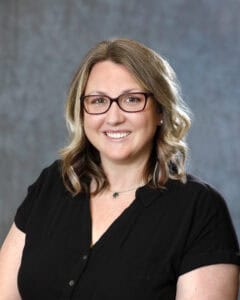
 Hannah has been a nurse for almost 17 years and has been a Home Visiting Nurse with Nurse Family Partnership in Billings for three years.
She and her husband have six children – fostering and adoption are part of their story – and Hannah will be the first to tell you that she loves her role as an RN. But even more, she adds, she loves each of the families who have given her the honor of being invited into their stories.
I always tell people, “you don’t end up in this job by accident.”
Since I was little, I’ve always, always loved moms and babies. I was a missionary kid and I think that’s just part of my DNA – I knew I wanted to be a nurse since childhood.
When I was in high school, I actually interned with a midwife and I got to follow her on some prenatal appointments and several deliveries. On one of the deliveries she didn’t make it in time. So at 16, I helped the mom deliver and I actually caught the baby. It was life changing. Just a really incredible experience to see what it looks like to support a woman during pregnancy, then during labor and delivery, and postpartum.
From my personal experience, I had my first baby during finals week in between my two years of nursing school and when I graduated, I had a 1-year-old. My husband and I went on to have six kids within eight years – three biological and three adopted. And through that process of fostering especially, I feel like it really gave me a heart for mamas who were struggling and wanted to be moms, but didn’t have support systems in place, or didn’t have people advocating for them, or advocating for their babies.
I actually stepped into home visiting from being a NICU nurse. I’d been a NICU nurse for a long time. I was also a flight nurse for a while – but there was not a good work/life balance. I was like “there has to be a way that I can still take care of mamas and babies and be a good mama myself.” So I legitimately just Googled “Mother/ Baby, Nurse”- and this position popped up.
I get the privilege of being there through pregnancy, which is such a pivotal time for a mom – and then through the first two years of baby’s life, which is so foundational. This has been such a gift to me, because that is something I didn’t get in the NICU.
There are so many joys and heartaches we are invited to share in. Sometimes a client’s mom – maybe they don’t have that relationship. Or they’re estranged or, you know, her mom isn’t alive anymore. They need somebody who can rejoice with them. Who can sit in the pain with them. Just continue to walk every step of these critical first few years with them. Consistency is huge. For some moms, we are the longest and most consistent relationship they have ever had. You really, really do give these families your heart. We pour our blood, sweat, and tears when walking through the hardest of times with them, which is such an honor.
I had an experience with a mama where I went to the first postpartum visit and I walked in the door and she was holding her baby. And I was just like, “Oh my gosh, she’s beautiful.” And she was like, “I want you to hold her – I want you to be the first to hold her.” And I just … it wrecked me.
We really work hard to try to collaborate. And that collaboration really looks like bringing in the right people. Sometimes these are connections for behavioral/mental health or housing. One of the first things we ask moms is, “Do you have Medicaid?” “Are you connected with WIC?” “What’s your living situation?” We can’t really go further until those necessities, those high needs are met. Nothing else really matters. Those are the priorities, you know, the focus initially when we start meeting with mamas.
I do feel like the acuity of the situations that our mamas are in, just in the three years I have been here, has significantly increased. When I first started, we maybe had a mama whose main need was finishing high school. Or they needed housing or resources as far as, you know, just making the paycheck go through the rest of the month. Sometimes it was a relational issue.
But now I feel like with so many of our mamas that we’re working with, there’s mental health issues. There’s substance use issues. There’s intimate partner issues. There’s legal issues. Housing, I feel like, has been a constant the whole time I’ve been here. There’s just more acuity and complexity now.
Ultimately, it’s really trying to just meet them where they’re at and finding out what their priorities are. And remembering that their priorities may not be my priorities. So how can I support what is important to you?
The beautiful thing about Nurse Family Partnership is that this is evidence-based. The numbers really show the return on the investment. And yes, there’s the financial part of the investment, but it’s also the return on the investment of relationships. Of time spent with that person and the trust that is built. Home visiting is very valuable for our community because we have our eyes on the most vulnerable.
It’s breaking down walls where racism, economic status, and past experiences of judgment have created barriers. Home visiting nurses have the opportunity to get past all of that.
For me, visiting with mamas during pregnancy and continuing to care for them and their family until the baby turns two – that’s more than a two and a half year relationship. I don’t know any other area of nursing that I would get that opportunity to really be a part of a family’s story – just like each of them are a part of my story.
You can use the LIFTS Online Resource Guide to find home visiting programs across Montana—just type “home visiting” into the search feature. If you need help finding a program, you can also call the LIFTS Warmline at (406) 430-9100 for personalized assistance.

