
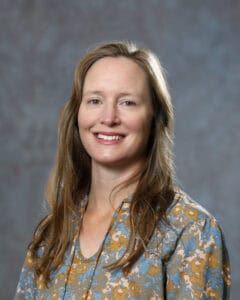
 Meredith is a Montana native and lifelong learner – so traveling and experimenting with different professional and personal endeavors has become a passion as she has explored and worked through the United States and South America. Once an aspiring Spanish professor, now a nurse home visitor for the perinatal population, her curiosity and drive to advocate and inspire positive change in perinatal health care has become a refined focus. When she’s away from work, Meredith can be found with her two children, Buckley and Iris, or navigating the terrain with her dog, Stanley.
From my perspective, a home visiting program is working to close the gaps and create a judgement-free presence in a way that’s unique to each person. It gives people the space to be who they are.
There are people who have the benefit of having a family or friends that really step up at this time, are there for them and do all the things that need to be done – I think that is wonderful. But I just don’t think that’s the case for the majority of families. So many of us are kind of on our own trying to figure things out, and you take on so much that you shouldn’t have to. Sometimes the difference is just having that support person who says: “Hey, let’s talk about it.” Or “What are you feeling? What do you need?”
Yes, there’s the healthcare aspect to home visiting – supporting people through that is important. But I think we get more of – “I just need somebody here to really be with me at this time in my life.”
I’m originally from Billings. When I was 18, I moved out to Oregon to go to school and I majored in Spanish. I traveled down to Mexico and South America and was on that path of just working towards becoming a professor in Spanish, but things changed and I ended up moving to Oklahoma and working with non-governmental organizations like Feed the Children and Boys and Girls Club. I had my first child during nursing school and was a night shift nurse while working in research. Then after Covid, I decided I needed to be closer to my home base, and we moved back from Kansas up here to Billings.
I had my second child and had the opportunity to use daycare and switch gears with a day shift job – and that’s how I came into this position as a home visiting nurse. In supporting other parents and mothers who were in the same boat as me, I feel like it was like I was widening my own community.
I’m the person who can provide advocacy and education and walk alongside new parents. I’m there to ask “How do you envision yourself? What issues have you been dealing with – and how would you like to approach those issues?” They’re doing the hard work – I get to be there to support them when they need me and tell them it’s going to be okay. That we’ll figure it out.
With the rise in the knowledge and advocacy of perinatal mental health, we’re allowing people to be vulnerable and not carry that weight all themselves. We’re also normalizing not feeling okay during a period of time when you’re told you’re supposed to be having the time of your life, you know? That’s not always the case for people. And if they’ve had a lot of their past, kind of creeping in during parenting – what do you do with all that?
A lot of people have burdens they’re carrying around, and they need to feel safe. That’s a big one. They have a need to feel like they’re not the only ones that are, say, having a child with developmental delays. They might just need to gain perspective on what’s going on right now.
We remind our clients that if anything, at least they know they have a choice. They can choose to call me – or not. They can see me – or not. And that in itself is an intervention and outcome for a person who may not have had a lot of decision-making opportunities in their life.
If there’s hesitation, that’s completely okay and normal. I’ve softened my approach a lot since I first started. You don’t need to sign anything or enroll. We can just talk or you can get to know me. Because some people do require a lot more relationship building upfront. It’s just allowing that person to be the decision maker. Maybe in the grand scheme of things, it’s just a little ripple in the pond, you know? But it’s something.
Everyone has an internal dialogue. It’s hard when the internal dialogue is not a positive one. I really like to support people by providing a positive dialogue no matter their situation. Reminding them that there’s still hope and there’s still the ability to change. This is not the end, you know? This is only the beginning.
You can use the LIFTS Online Resource Guide to find home visiting programs across Montana—just type “home visiting” into the search feature. If you need help finding a program, you can also call the LIFTS Warmline at (406) 430-9100 for personalized assistance.

